10 posts · Year-end review, spotlights, guides, and the carry report that launched the site
Dec 2025OpinionYear in carry: what we actually had in our pockets in 2025
Jan 2026SpotlightVosteed maker spotlight: the brand that's quietly winning
Jan 2026GuidesHow to sharpen a folder: the minimal setup that actually works
Feb 2026Opinion5 knives that replaced my Benchmade, and why I haven't looked back, and why I haven't looked back
Feb 2026SpotlightKnafs maker spotlight: Ben Petersen and the community-first knife brand
Mar 2026ListsBest CJRB knives ranked: AR-RPM9 deserves its own conversation
Mar 2026OpinionCarry culture vs. collector culture: the knife you open is the only one that matters: the knife you open is the only one that matters
Jan 2026GuidesHow to buy your first EDC knife: the Daily Steel version
Sep 2026OpinionWhat's in our pocket right now: fall 2026 carry report
Jul 2026ListsSuper steel shouldn't cost this much, and increasingly, it doesn't
Mar 2026ListsEDC fixed blades: a category that probably shouldn't exist and absolutely does
May 2026GuidesThe best knives for the beach: carry light, carry smart, accept the risk
← Back to archive
OpinionDecember 2025
Year in carry: what we actually had in our pockets in 2025
The year in review for a knife blog is a carry journal. Here's what actually lived in the rotation, not what we reviewed, not what we recommended, what we reached for.
There's a gap in knife media between what gets recommended and what actually gets carried. Reviews are written in the honeymoon period. Recommendations reflect affiliate considerations and searchability. The year-in-carry column is the honest one: twelve months of actual decisions, all the way through the mid-year switches and the seasonal adjustments and the moment when the knife you bought in March quietly stopped appearing in the pocket by October.
The Nitro-V Raccoon in the aluminum handle was the everyday driver through most of the first quarter. Its combination of Nitro-V steel's corrosion resistance and the aluminum handle's low thermal mass made it the right answer for cold mornings. The button lock stayed satisfying through hundreds of cycles without any loosening. The Raccoon remained in rotation through spring before the size calculus shifted toward the Cub.
May through August: summer rotations
The Raccoon Cub replaced the full Raccoon in May as primary carry, 2.0 oz disappears in shorts pockets in a way the Raccoon doesn't quite. The Kizer Parakeet showed up in June and immediately started getting more reach time than expected. Johan Jordaan's design carries like a knife that costs twice as much, and the Nitro-V blade stayed sharp through a full summer without requiring more than occasional stropping. The GiantMouse Riv came out in August for a two-week rotation and the flat grind on the MagnaCut blade is one of the best slicing experiences in this size category.
September through December: the serious knives
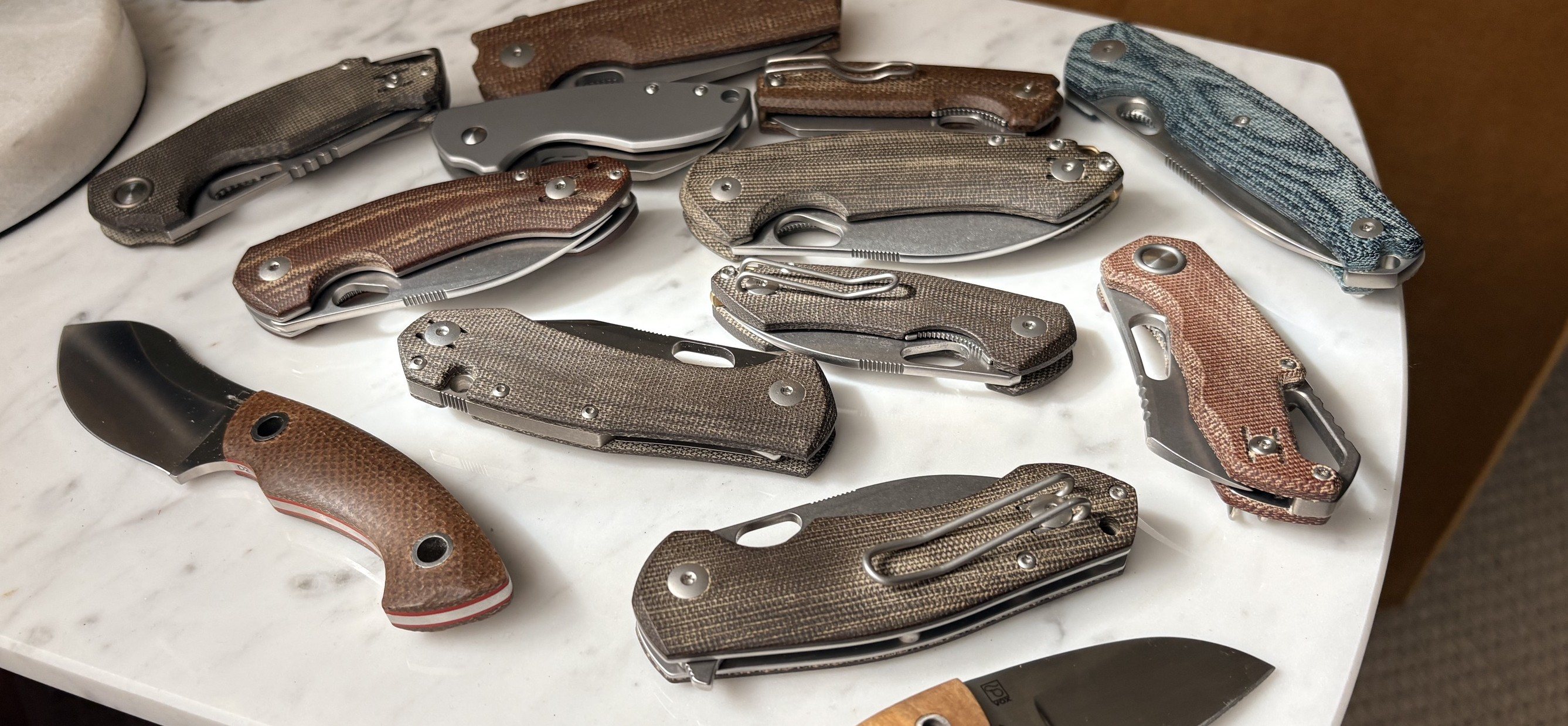
The Knafs Lander 3 clip point arrived in November and immediately started displacing everything else. The brown paper micarta is tactile in a way that keeps the hand reaching for it, and the S35VN clutch lock performs at the level the specs imply. The Artisan Cleo copper has been in the secondary pocket since October, developing carry patina that's specific and beautiful. The WESN Allman made a December appearance that's likely to extend into January. S35VN in a package that disappears in dress pants has a specific use case that nothing else fills.
What didn't make it
The PM2 rotated through in March and is genuinely excellent. It's also 3.75 oz and very few days in 2025 had situations where nothing else served equally well at significantly lighter weight. The PM2 earns its reputation. The question is whether the reputation matches the specific use case, and for most of 2025, the answer was "not over the Raccoon."
The honest summary: Vosteed owned the year. Kizer earned significant rotation time. Knafs closed strong. GiantMouse remained the benchmark for the category it invented. And the carry you actually use proved again to be more important than the carry that photographs best. See you in 2026.
Vosteed maker spotlight: the brand that's quietly winning
No press releases. No controversy. Just a consistent string of knives that outperform what the price tag implies, and a community that's starting to notice.
Vosteed doesn't have a dramatic founding story. There's no famous designer whose name anchors every product, no single knife that became a cultural moment. What they have is a design department, led by a designer known as Yue, that makes decisions as if the person carrying the knife actually matters, and manufacturing that executes those decisions at a quality level that should be more expensive than it is.
The Yue design language
You can recognize a Yue design without seeing the logo. Rounded, ergonomic handles that prioritize the feel in the hand over the look on a shelf. Blade geometries that serve the carry context. Locking mechanisms chosen based on how you'll close the knife rather than what sounds impressive. The Raccoon, Corgi, Marten, these share a coherent point of view: a daily carry knife should disappear into the hand so completely that you stop thinking about it and start thinking about what you're cutting.
The lock innovation
Vosteed's Trek Lock, their proprietary button liner lock implementation, is one of the more considered additions to the production folder space in recent years. Spine-side button placement means closing never puts your fingers near the edge. The symmetrical handle makes the lock position feel natural regardless of grip angle. The Vanchor Lock in premium Corgi and Raccoon variants refines the concept further with magnetic-assisted lockup that increases both tactile feedback and mechanical security.
These aren't gimmicks. They're genuine improvements to how a production folder operates daily, arriving at prices where competing implementations either don't exist or cost significantly more.
The steel story
Vosteed specs steel honestly. 14C28N at entry level is a genuine choice, one of the better entry-level stainless steels, well-suited to pocket carry corrosion resistance demands. Nitro-V at mid tier is a real upgrade in toughness and edge retention. 154CM in the Marten is an American premium steel rarely found under $100. S35VN in the Corgi V 295 and Raccoon V positions those premium variants as genuinely competitive with knives costing significantly more. The hierarchy is logical and every tier earns its price point.
Why more people don't know about them
Vosteed doesn't have the marketing infrastructure that drives search results. They're not sponsored by the YouTube channels with the biggest audiences. What they have is knives that earn repeat buyers and a community on r/EDC and knife forums that passes the word like people who found a restaurant that doesn't advertise. That's a slower growth model and a more durable one. The brands that grow on genuine product quality rather than marketing investment are the ones worth recommending five years later. We'll be recommending Vosteed five years from now.
How to sharpen a folder: the minimal setup that actually works
You don't need a Wicked Edge or a weekend course. You need two things and fifteen minutes twice a year.
The sharpening industry would like you to believe that maintaining a knife edge requires significant investment in equipment and skill. It doesn't. Maintaining a working edge on a daily carry folder requires approximately two tools and patience. Getting that edge genuinely sharp requires a bit more refinement, but it's not a specialist skill.
The minimal setup
A Spyderco Sharpmaker is the starting recommendation and has been for twenty years because it works. Two ceramic rods in a V-shaped base, a consistent angle built into the design, instructions that are correct. It handles most steels well including S35VN. It will struggle with super steels like M390 and MagnaCut, these require diamond rods, but even then the Sharpmaker's diamond rods are a simple add-on purchase.
The second tool is a leather strop. Stropping realigns microscopic teeth on a worn edge and can restore a knife from "dull but functional" to "sharp enough to push-cut paper" in under a minute. Learn to strop first. Sharpen last.
The technique
For the Sharpmaker: hold the knife vertical, edge facing down. Draw the blade edge-trailing down each rod, alternating sides, with light to medium pressure. Count strokes and alternate evenly. The rods set the angle, your job is consistent pressure. Five to ten passes per side on fine rods for maintenance; start on medium rods for real work.
For stropping: hold the strop flat. Draw the knife spine-first along the leather, opposite direction from sharpening, with light pressure. Ten passes per side. This step is what most people skip and it accounts for half the final sharpness.
How often
For mid-tier steel (14C28N, D2) in daily carry: strop every week or two, sharpen every two to three months. For premium steels (S35VN, MagnaCut): strop occasionally, sharpen twice a year. The "sharp enough to push-cut newspaper" standard is more achievable and maintainable than "shaving sharp" for most people's practice.
The diamond exception
If you carry M390, 20CV, or MagnaCut, add a diamond plate or diamond rods. Ceramic can maintain these steels between sharpenings but struggles to reset an edge from scratch. The DMT Diafold at around $30 is the portable, effective answer, takes any super steel back to biting sharp in minutes. Not optional if you carry super steels with any regularity.
5 knives that replaced my Benchmade, and why I haven't looked back, and why I haven't looked back
Benchmade makes good knives. They're also not the only answer, and for four of these five, not the best one at the price.
Let me be precise: Benchmade makes genuinely well-built American production knives. Their AXIS lock is an engineering achievement. Their warranty is real. Nothing in this post is a dismissal of the brand. This is specifically the observation that in 2025–2026, the knife market has evolved to a point where Benchmade's historical pricing advantage no longer holds in the same way.
The Mini Grip is a beloved knife with decades of track record. The Vosteed Raccoon is a better knife at $38 less. Nitro-V is a more modern steel than S30V. The button lock is safer to close one-handed. The ergonomics are better for gloved carry. Benchmade's AXIS lock is a superior mechanism, acknowledging that honestly, but the rest of the value proposition has flipped. KnifeCenter ($72)
S35VN vs S30VClutch lock vs AXISOpen source vs proprietary
The Bugout is lighter. The Lander 2 has better steel, open-source scales, and costs $55 less. The clutch lock is AXIS-style without the Benchmade license fee. The Lander 2 is a community knife that improves over time. Both succeeded at their design goals, one of those goals was more interesting. KnifeCenter ($144.99)
For years the 940 came in S30V at prices north of $200. The Begleiter 2 arrived with S35VN and a button lock at $134. The 940 in MagnaCut is harder to argue with, but that version didn't always exist. The Begleiter 2 is a better value; the 940 is a better designed knife. Depends on how you prioritize. KnifeCenter ($134.95)
The bluntest comparison. The Conspirator does the daily EDC job at $57–80. The Mini Bugout does it at $175. The Mini Bugout's AXIS lock and American manufacturing are genuine, but the Conspirator is within the margin of error on performance and the price difference is real money. If you're building an EDC practice, start here.
MagnaCut vs S30V/S45VNDuraLock vs AXISUSA made vs USA made
The honest head-to-head: both American-made, similar price, competing directly. The Bel Air has MagnaCut; the Griptilian has S30V or S45VN. The DuraLock mechanism is excellent, different from AXIS but not worse. Genuinely close. We'd take the MagnaCut. KnifeCenter ($154.99)
Knafs maker spotlight: Ben Petersen and the community-first knife brand
Ben Petersen didn't set out to be a knife designer. He set out to make good YouTube videos. Fifteen years later he's built one of the most genuinely community-oriented brands in the production knife world, and the knives themselves are excellent.
There's a version of the Ben Petersen story that starts with Knafs and works backward, explaining the brand's open-source philosophy and community engagement as if they were strategic decisions. That version misses the point. The better version starts in 2011, when Petersen took a part-time gig making YouTube videos for a knife retailer in Utah, half-expecting to move on after his internship ended. He didn't move on. The knife industry absorbed him, and he spent the next eight years at Blade HQ and then CRKT, learning the retail and manufacturing sides of the business from the inside while building one of the most recognizable voices in online knife media.
Knife Banter and the years that built the foundation
At Blade HQ, Petersen co-created and co-hosted Knife Banter, a YouTube show that ran nearly every week for three years and accumulated millions of views. His on-screen tagline, "What iiiiiiis up guys," became a genuine community in-joke rather than a marketing affectation, which is a difficult thing to engineer and an impossible thing to fake. He became known as Ben Banters. The show was good: accessible without being condescending, knowledgeable without being gatekeeping, funny without being performative. It introduced a generation of knife buyers to the hobby in a way that made them feel welcomed rather than evaluated.
What that period also did was give Petersen an unusually complete picture of the knife industry, what retailers need, what manufacturers can and can't do, what buyers actually want versus what they say they want, and where the gap between production quality and price was widest. He handled thousands of knives. He read the comments. He talked to the customers. When he eventually started sketching his own designs, those years of accumulated context came with him.
The Banter, the Baby Banter, and the WIUG mark
Petersen's first production design, the WE Knife Banter, was announced in January 2020 and became the clearest early statement of his design sensibility: a sub-3" EDC folder that deliberately felt familiar without being derivative. He described it as a conglomerate of everything he loved, a Protech clip, Spyderco G10, a CRKT blade shape, Benchmade sizing, assembled into something coherent and simple. The WIUG maker's mark, an acronym of his YouTube catchphrase, appeared on the blade, and it has appeared on his designs ever since.
The CIVIVI Baby Banter followed, applying similar logic to a smaller, more accessible package. The Baby Banter became one of CIVIVI's best-selling models and remains a consistent recommendation at its price point for people who want a quality sub-3" daily carry without overthinking it. The WE Sendy extended the collaboration further. Each of these knives carries a recognizable thread: compact, clean, designed around what the carrier needs rather than what looks impressive on a spec sheet.
Knafs, the Lander, and building something owned
Petersen and his wife Athena founded Knafs in 2018 while he was still working full-time in the industry, it started as a side project producing a knife anatomy poster, then grew into accessories, maintenance tools, and eventually the company's own knife line. They took Knafs full-time in 2022, moved into a dedicated facility in Clearfield, Utah in 2023, and have been building it into a genuinely self-sufficient knife brand ever since. In 2024 alone they ran three successful Kickstarter campaigns, the Lander 3, Lander 4, and Sancho Pen, raising $294,000 from backers who had bought into the project before the product existed.
The Knafs Lander series is the core of the lineup and the most complete expression of what Petersen has been working toward since he started thinking about what he'd want in a knife. The Lander's fast-swap scale system, two screws, no pivot disassembly, scales off in under a minute, was the first expression of a right-to-repair philosophy that runs through everything Knafs makes. The open-source CAD files on GitHub, licensed under Creative Commons so anyone can download and 3D print their own scales without paying Knafs anything, are the second. Replacement screws, spare parts, and full disassembly guides are available by default rather than after a warranty claim. The brand doesn't just permit modification. It provides the infrastructure for it and then gets out of the way.
The Lander 3 clip point, currently in our carry rotation, is the version of the concept that feels most resolved. S35VN, the clutch lock that Knafs has made their signature mechanism, compact enough to carry anywhere, with a blade geometry that does daily cutting tasks as well as anything at this price. The Lander 4 extended the philosophy to a fixed blade at 2.6", applying the same swappable scale logic to a format that doesn't require it but is better for having it. Each iteration incorporates direct community feedback, not focus group data, but forum discussions and owner reports that Petersen reads and responds to himself. The Lander 3's return to the original's compact dimensions while retaining the Lander 2's clutch lock was a direct response to owners who found the Lander 2 slightly large. This is not brand narrative. It's operational practice.
The ambassador question
The word "ambassador" gets used loosely in the knife industry, usually meaning someone who promotes products they've been paid to promote. Petersen's relationship with the knife community is different in kind. He spent years making genuinely educational content that helped people understand knives better, at a time when that content made them more valuable as customers to brands other than his own. He built Knife Banter into a show that grew the hobby rather than just capturing existing hobbyists. He launched Knafs@Nite in 2024, a YouTube continuation of that approach, now with Knafs as the context, and ran 27 episodes in the first year with 2.1 million views. He gives talks at universities about entrepreneurship. He replies to customer emails. He is, in a phrase he's used himself, trying to be the facilitator rather than the ringleader, someone who helps the community grow in ways that don't depend on him personally.
What makes this worth noting, and what makes the Knafs story worth telling to anyone in or adjacent to the knife industry, is that it's genuinely rare. The production knife world has brands that communicate well, brands with strong aesthetics, brands with excellent manufacturing. Brands that treat the people who carry their knives as collaborators in an ongoing conversation, that subset is considerably smaller. Petersen has been building toward that for fifteen years, and Knafs is what it looks like when the foundation is actually there.
What Knafs makes right now
The current Knafs lineup centers on the Lander series, the Lander 1 (compact, 14C28N, QSP manufacturing), Lander 2 (larger, S35VN, Kizer manufacturing), Lander 3 (compact again, S35VN, clutch lock, our pick), and Lander 4 (fixed blade, 2.6", S35VN or 14C28N). The Lulu is their USA-made fixed blade, built by White River Knives in a tribute to a Montana mountain pass and representing the premium end of the lineup. The Lander 6 is a keychain knife built specifically to bring younger and newer carriers into the hobby. The company also produces the Knife Anatomy Poster, the product that started everything, alongside maintenance mats, titanium desk tools, and a growing accessories line. The whole catalog reflects the same sensibility: things Ben Petersen would personally use, designed to the standard he'd hold them to.
Knafs Lander 3 (clip point)
S35VN · clutch lock · brown paper micarta · compact · the current recommendation
~$128
S35VNcompactclutch lockfast-swap scalesopen-source CADWIUG maker's mark
"The most resolved version of the Lander concept yet. The clip point is Ben Petersen's most beautiful knife and the one we reach for most often."
The Lander 3 clip point is the knife that convinced us Knafs had arrived at something genuinely special rather than just consistently good. The proportions are right in a way that's hard to articulate, the clip point geometry has a warmth that the sheepsfoot and drop point versions don't quite achieve, the brown paper micarta develops character over time, and the clutch lock operates with a mechanical satisfaction that rewards every open and close. S35VN is correctly specified for a knife carried and used daily. Fast-swap scales remain, open-source CAD files remain, and the ethos remains intact in what is materially a better knife than the one Petersen started with.
CJRB is Artisan Cutlery's value brand, and the value is real. AR-RPM9 steel on knives under $60 is a story the knife community has figured out and the mainstream hasn't.
AR-RPM9 is CJRB's proprietary steel, a spray-formed alloy that compares favorably to D2 with the addition of genuine corrosion resistance. It sharpens easily, holds an edge well, and doesn't require the maintenance anxiety D2 creates in wet conditions. Finding it on knives starting under $40 makes other brands' budget offerings look like genuine compromises.
"AR-RPM9, ceramic bearings, and a button lock at $57. The market still hasn't fully processed this."
The button lock with ceramic bearings makes deployment and closing genuinely satisfying, the kind of fidget-friendly action that usually lives at twice this price. AR-RPM9 holds its edge through weeks of daily carry and sharpens without drama. Start here. KnifeCenter (~$57)
Clean design, functional ergonomics, smooth thumb stud, deep carry clip. The first knife recommendation when budget is genuinely $40 or less. KnifeCenter (~$35–38)
Sub-3" CJRB option, clears most blade length restrictions, light enough not to notice, priced to be a second or third carry. Buy two. Keep one in a bag. KnifeCenter (~$40–45)
The Pyrite's button lock mechanism with AR-RPM9 blade, FRN polymer handles. At ~$30 it's the cheapest button lock AR-RPM9 folder available, with the same action satisfaction as its heavier sibling. KnifeCenter (~$30)
The CJRB case in one sentence: Artisan Cutlery took their premium manufacturing infrastructure, applied it to AR-RPM9 steel at accessible price points, and created a brand that makes the budget knife conversation significantly more interesting than it was before they existed.
Carry culture vs. collector culture: the knife you open is the only one that matters: the knife you open is the only one that matters
Both cultures are real. One of them is the reason this site exists.
There are two distinct populations in the knife hobby, coexisting in the same forums without always acknowledging how different their actual relationship with knives is. Collector culture prizes the acquisition, the display, the documentation of what's been owned. Carry culture prizes the use, the carry wear, the working relationship with a tool over time. Neither is wrong. They're different hobbies that happen to involve the same objects.
What collector culture gets right
Knife collecting preserves knowledge. Collectors understand historical significance of designs, track provenance on custom pieces, maintain institutional memory of the industry. They fund premium production by paying for limited editions. And they genuinely appreciate craft in a way carry culture sometimes undervalues, the execution of a 70-degree edge bevel is worth noticing even if you're going to scratch the blade face in the first week of carry.
What carry culture gets right
A knife in a display case cuts nothing. A knife in a pocket cuts everything it's asked to cut, develops a relationship with the person carrying it, and demonstrates through real use which specifications actually matter. Carry culture is empirical in a way collector culture can't be, you learn more about what a knife does from six months of pocket time than from six years of handling at shows.
The carry culture position, that the knife you actually carry is infinitely more useful than the knife you don't, is not an argument against collecting. It's a reminder that the point of the tool is the use. If you're buying knives to appreciate them aesthetically and intellectually, that's a complete and valid reason. If you're buying knives to make cutting tasks easier and more enjoyable, carry them hard, sharpen them when they need it, and stop worrying about the scratches.
The Daily Steel position
This site exists in carry culture. We write about knives we carry, recommend knives we'd carry, and evaluate performance through actual use. The reader who wants to know which $60 folder they'll actually reach for at 7pm when they need to cut a rope: that's our reader. Both cultures are welcome here. The one who carries their knives feels slightly more at home.
How to buy your first EDC knife: the Daily Steel version
Every knife site has a beginner's guide. This one starts where you actually are, not where the industry wants you to be.
Most first EDC knife guides are really first Benchmade or first Spyderco guides in disguise, they mention budget options as concessions, then spend the rest explaining why expensive knives are worth it. This guide doesn't do that.
Start with a realistic budget
The honest budget for a first EDC knife is whatever you can spend without feeling anxious about losing or scratching it. If that's $30, your knife is the CJRB Feldspar Small. If it's $60, your knife is the Vosteed Raccoon Cub or CIVIVI Elementum. If it's $100, your knife is the Vosteed Raccoon or Corgi. None of these are compromises. Don't spend $175 on a first knife, not because first knives don't deserve good money, but because you don't know what you want yet. Six months of carry with a $60 knife will teach you whether you prefer 2.5" or 3.25" blade, whether you care about steel, whether you want something that disappears in the pocket or has presence in the hand.
Blade length: smaller than you think
First-time buyers consistently overestimate how much blade length they need. A 2.5–3" blade handles 95% of daily cutting tasks as well as a 3.5" blade and carries more comfortably in more contexts. Sub-3" also clears most local blade length restrictions without research.
Blade steel: don't worry about it yet
14C28N, D2, AR-RPM9, Nitro-V, any of these are completely appropriate for a first knife. The steel conversation becomes interesting after you understand how you use a knife and in what conditions you carry it. Before that, it's a specification that will eat your research time without improving your carry experience. Buy any of the above and use it for six months. Then decide if you want to upgrade the steel in your next knife, at that point you'll know exactly why.
Lock type: the one decision that matters
Traditional liner locks require moving your thumb into the blade's path to close. Compression locks and button liner locks close without that risk. For most people, a button lock or compression lock is safer and easier to operate one-handed in any conditions. The Vosteed Raccoon Cub (liner lock with good ergonomics), Vosteed Corgi (Trek Lock button liner), and CJRB Pyrite (button lock) represent different excellent approaches under $75.
The one recommendation
If you want a single answer: buy a Vosteed Raccoon Cub ($42–49) or CJRB Pyrite (~$57) and carry it for six months before buying anything else. Both have steel good enough to tell you what you think of steel. Both have design quality to show you what you want more of. And both are inexpensive enough that the cost of the education is reasonable. Everything else follows from the carry data.
What's in our pocket right now: fall 2026 carry report
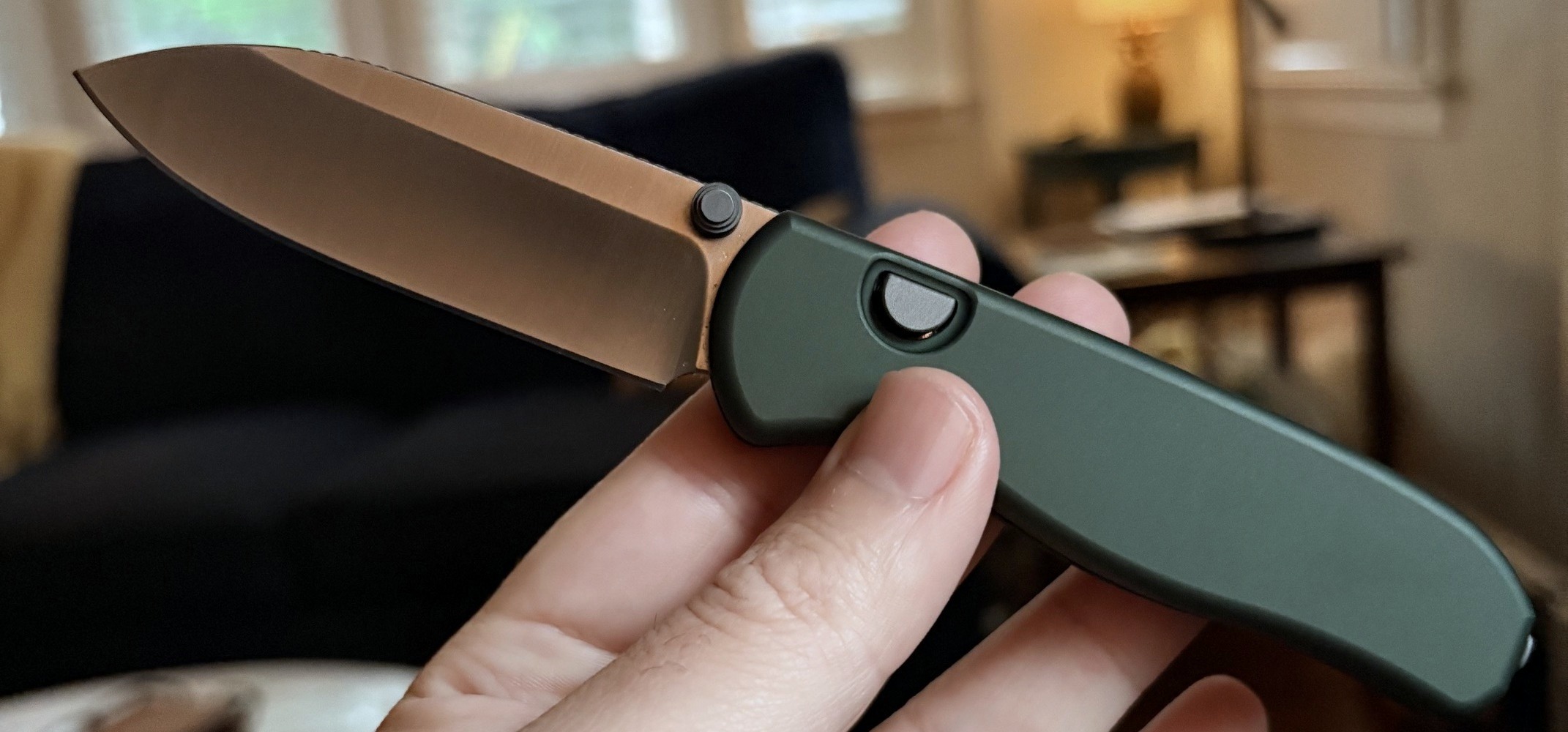
Aluminum scales in British Racing Green, a deep hollow grind in M390, this season's primary answer for pocket time. It's one piece of a rotation that's leaning hard into fall elsewhere too: micarta warming up, brass catching low light, badges worth a second look.
We build this report around what's actually showing up in the pocket every morning, not what we reviewed most recently or what carries the best affiliate rate. Eight weeks in, here's the honest answer.
The green micarta Biblio has taken over as the fall answer. Ansø and Voxnaes, Italian-made, and the micarta only improves with a season's worth of pocket wear, the kind of texture and color shift no synthetic scale can fake. It's been the first knife back in the pocket every morning since the weather turned.
Secondary carry: Kizer Drop Bear Zero (British Racing Green, M390, Knivesandtools.com)
The British Racing Green M390 version from Knivesandtools has been getting real time this season. Aluminum scales in that green, a deep hollow grind on the M390 blade, and a button liner lock. It's the knife that makes you glad you didn't wait for the hype to die down.
Office carry: Spyderco Urban SlipIt (M398)
The Urban SlipIt has become the default anywhere a locking blade would raise an eyebrow. M398 in a 2.49" slip joint, no lock to explain, no clip to snag on a blazer pocket. It goes everywhere and asks nothing of the room it's in.
Fifth pocket: the Sprite
The Sprite, from Bestechman, has claimed the fifth pocket slot this season. M390 blade, titanium handle, and quite possibly the smallest crossbar lock on the market, small enough that running the lock becomes its own little fidget habit. It's a case of a maker choosing exactly the right materials and steel to make a genuinely small knife feel special instead of just small.
What we keep almost reaching for
The Fox Baby Core in brown micarta is less "in rotation" and more "the knife I keep yearning to carry." It hasn't fully displaced anything yet, but as the weather cools and the wardrobe shifts, from shorts pockets to jacket pockets, from summer tasks to fall ones, it's the one that's going to earn more time. The warm brown micarta and brass hardware are doing exactly what fall carry should do: quiet, a little rugged, better with age.
The carry continues.
The rotation changes with the season, not with whatever's trending. We'll keep writing about the knives we actually carry, recommending the ones we believe in, and holding the line that a $60 knife you carry every day beats a $300 knife you don't. Thanks for reading. Keep your knife sharp.
Super steel shouldn't cost this much, and increasingly, it doesn't
M390. S90V. MagnaCut. A few years ago these steels lived almost exclusively on knives over $200. The market has moved faster than the conversation has. Here are six knives that prove it.
There's a lazy version of the super steel conversation that goes like this: premium steels cost more to produce, so knives in premium steels cost more to buy. The logic was sound and broadly true for most of knife history. What's changed is Chinese manufacturing scale and the willingness of brands like Vosteed, Geo Knife, CJRB, and QSP to put those steels into production folders at prices that should, by the old logic, be impossible.
The three steels in play here each have a distinct character worth understanding before the list. M390 is Böhler's Austrian stainless powder steel: exceptional corrosion resistance, high edge retention, and a mirror-polish capability that makes it particularly attractive for premium aesthetics. S90V is Crucible's American vanadium carbide formula: near-legendary edge retention, harder to sharpen than M390 but capable of an edge that holds through months of daily carry without complaint. MagnaCut is the newest entrant, engineered specifically to balance toughness, edge retention, and corrosion resistance simultaneously in a way no previous steel had managed. All three are meaningfully better than S35VN for long-term edge retention. All three were, until recently, essentially inaccessible below $175.
These six knives are why that sentence is past tense.
CPM-S90V3" bladesheepsfootliner lockaluminum or micartaBladeHQ exclusive
"$68 for S90V. Read that again."
The QSP Penguin is already one of the most recommended budget EDC folders in D2. The S90V variant, a BladeHQ exclusive, takes the same proven platform and upgrades it to CPM-S90V at $67.99. This is not a compromised knife with premium steel bolted on. The sheepsfoot geometry is excellent for controlled slicing, the liner lock is solid, and the thumb stud action is smooth on washer bearings that have aged well in the platform. The only honest caveat: S90V needs diamond sharpening to reset from dull, ceramic rods will maintain the edge but won't bring it back from scratch. That is a small ask for a knife at this price in this steel, and it remains the headline number in any super steel value conversation.
M390 · 3" · crossbar lock · G10 · the cheapest M390 production folder available
$87.20
M3903" bladeclip point or drop pointcrossbar lockG10 handles0.1" blade stock
"Under $90 for Böhler M390. Geo Knife has no business charging this little."
Geo Knife hasn't gotten the recognition it deserves, partly because the name communicates nothing about the product and partly because the knife community is slow to trust unfamiliar brands at low prices. The Ethereal Cutter earns trust quickly. A 3" M390 blade in a flat-ground clip point or drop point geometry, crossbar lock for finger-safe AXIS-style closing, and G10 handles at $87.20 from KnifeCenter. This is the cheapest M390 production folder currently available from a reputable retailer. The 0.1" blade stock and flat grind make it a genuine slicer despite the budget-adjacent price. The titanium honeycomb versions at $159.20 are the aesthetic argument for the same steel; the G10 is the practical carry argument. Both are correct.
M3902.92" bladeBowie or Zulucrossbar lockCNC aluminumSAS swappable scales
"M390, swappable scales, and a spring tension system tunable by the user. Vosteed is still doing things nobody else is doing."
The Vombat is Yue's Swappable Adjustable Scale concept applied to an M390 folder, and it's one of the more interesting knife designs of the past year. Two blade shapes, the conventional Bowie drop point and the more aggressive Zulu, in the same M390 package. The SAS system lets you swap handle scales with a few screws and dial in the crossbar lock's spring tension using music-note indicators on the lock mechanism, which is a level of user tunability you don't usually see below $300. Dual thumb studs, triple standoff system for lanyard flexibility, CNC-milled handle quality consistent with everything else in the Vosteed lineup. At $139 for M390 this earns a position on any value list without qualification.
"American-made MagnaCut at $155. The conversation about Kershaw being irrelevant ends here."
MagnaCut is Larrin Thomas's engineering achievement, the first steel designed from scratch to simultaneously maximize toughness, edge retention, and corrosion resistance without the traditional trade-offs. Finding it on a USA-made production knife at $155 was genuinely surprising when the Bel Air launched. The DuraLock crossbar mechanism is excellent, different from Benchmade's AXIS but not inferior, and the KVT ball bearing pivot gives the manual deployment a feel the price doesn't suggest. Thin blade stock, full flat grind, available in aluminum and several micarta options. The micarta clip point at $154.99 is the pick. Kershaw hasn't been on our recommended list until now; the Bel Air earned the spot.
"S90V in sandblasted titanium, crossbar lock, David C. Andersen design at $180. CJRB is outrunning its own reputation."
The CJRB DCA Maximal is David C. Andersen's first folding knife design, and it announces itself clearly: S90V blade, sandblasted titanium handles, crossbar lock, 2.95" drop point, reversible clip. This is a compact premium EDC that uses CJRB's manufacturing infrastructure, the same factories and tolerances that produce the Pyrite and Feldspar, and applies it to genuinely top-tier materials. S90V in titanium at $180 is a pricing anomaly that should probably not exist. The Maximal exists anyway. Andersen's design language leans clean and carry-forward rather than tactical, which means it works in the same professional contexts as the QSP Penguin but at a more premium material tier. This is the S90V recommendation for someone who wants to carry the steel rather than just own it.
S90V · 3.04" · top liner lock · Grade 5 titanium · 0.315" total thickness
$179
CPM-S90V3.04" bladedrop pointtop liner lockGrade 5 titanium0.315" total thickness
"S90V in Grade 5 titanium at 0.315" thick. The best super steel value case at the top of this price range."
The Porcupine TiSlim in S90V is brand new and already the most compelling super steel value argument at the $175-200 tier. Grade 5 titanium handles, precision CNC-machined, at 0.315" overall thickness, that is genuinely and impressively slim. The S90V blade is 3.04" of drop point geometry deployed via dual-tone thumb studs with spine jimping where control matters. The top liner lock keeps fingers clear of the blade path and adds fidget-friendly quality to the close. The 3D-milled titanium clip mirrors the Porcupine's signature texture and carries secure without bulk. At $179 for S90V in Grade 5 titanium this is the premium entry on this list, and it earns that position completely.
The short version: M390 is now accessible under $90 if you know where to look. S90V is accessible under $70 if you know where to look. MagnaCut from a USA manufacturer is under $160. The steel upgrade conversation used to be about whether you could afford premium steel. Now it's about whether the price gap between entry-tier and super-tier steel is large enough to justify the extra sharpening difficulty. For most daily carry purposes, the honest answer is no. S35VN performs excellently and sharpens more easily. But if you want the steel and you're paying attention to the market right now, you're paying less than ever to get it.
The best knives for the beach: carry light, carry smart, accept the risk
The beach is harder on knives, and harder on your attachment to them. Salt air, sand, and the general chaos of a day at the water create genuine loss risk. These six are worth bringing anyway, with varying degrees of caution.
The beach asks a specific thing of a knife. It needs to disappear into a swim trunks pocket or a bag without weight or bulk. It needs to not corrode when salt air and sunscreen get into it. It needs to work if sand finds its way into the mechanism, or at minimum, flush out easily when you rinse it. And somewhere in the back of your mind, you need to be at peace with the idea that it might not make it home.
That last requirement quietly eliminates most of the knives we actually love. This guide works outward from the aspirational pick, the knife you'll bring to the beach but baby the whole time, through to the knives you can genuinely throw in a bag pocket, forget about, and not feel anything particular if they end up in the sand.
Benchmade Mini Bugout
S30V · 2.82" · AXIS lock · Grivory · 1.5 oz · the one you'll baby
$175
S30V2.82" bladeAXIS lockGrivory handles1.5 ozUSA made
"The best pure knife on this list, and also the most expensive. Whether that's a problem depends entirely on you."
At 1.5 oz, the Mini Bugout is lighter than almost anything you'd consider putting in the same category. The Grivory handle in orange or white or blue looks genuinely good at the beach, casual, bright, not tactical. The S30V blade is corrosion-resistant enough for salt air. It disappears in a pocket in a way that larger knives simply don't. All of that is true, and the Mini Bugout is a better knife than anything else on this list.
Here's the honest conversation: at $175, this sits at the upper edge of what most people would consider reasonable beach carry. The beach has a way of claiming things, bags get upended, pockets get forgotten, sand moves. Our position is that we'd bring something less expensive to the beach and save the Mini Bugout for contexts where we're not actively accepting loss risk. That said, some people carry expensive things to the beach and are fine with it. If you're that person and you want the best possible knife in a swim trunks pocket, this is it. The AXIS lock and fine sand do have a complicated relationship, the crossbar channel can pack with grit and require a rinse, but it clears easily with fresh water. Know what you're bringing, and bring it accordingly.
12C27 Sandvik · 3" · Virobloc ring lock · beechwood · 1.2 oz · the romantic choice
~$15
Sandvik 12C273" bladeVirobloc ring lockbeechwood handle1.2 ozmade in France
"$15. French-made since 1890. Looks great in a beach bag. The one you buy two of."
The Opinel No. 7 is the knife Picasso carved with and the knife a French farmer has had in his pocket for a hundred years. It is also $15 and 1.2 oz and comes in colors that look genuinely beautiful at the beach. The Virobloc ring lock, a rotating collar around the handle, has no springs, no moving parts to jam, no channels for sand to hide in. You twist it open, the blade deploys with a satisfying arc, you twist it closed. That's the whole mechanism, and it is essentially sand-proof.
One honest caveat: the beechwood handle swells when wet. If you close the blade and then submerge it in seawater, the wood can swell enough to make reopening it require some effort. The fix is simple, keep the blade open or dry it out before closing, but it's worth knowing. Get the stainless version, not carbon steel. At this price, buy two: one for the beach bag, one for the kitchen drawer.
AR-RPM93.34" wharncliffebutton lockFRN handles2.82 oz
"$30, button lock, FRN handles, wharncliffe blade. Basically built for this."
The Pyrite-Light is the most practical knife on this list for actual beach use. The FRN handle is a single molded polymer shell, no seams, no crevices, nowhere for sand to pack in and stay. The button lock is side-mounted and finger-safe, with no open channel across the spine. AR-RPM9 steel is corrosion-resistant enough to shrug off a saltwater rinse without drama. The wharncliffe blade is a controlled slicer that's useful for cutting rope, fishing line, fruit, or anything else the beach requires. At $29.95 it sits firmly in the "lose it without a second thought" category.
Available in blue, green, amber, and black FRN, the blue version is the obvious beach pick and costs nothing extra. Buy this one if you want to actually use a knife at the beach without thinking about it.
D2 · 1.5" · liner lock · GRN · 1 oz · the one you forget is there
$39.99
D21.5" bladeliner lockGRN handles1 oz
"1 oz. Ocean blue GRN. Throw it in the bag and forget it's there until you need it."
The Tinkham is UCO's smallest folding knife, 1.5" D2 blade, liner lock, GRN handles, 1 oz total weight. It comes in ocean blue, tiger orange, and coal gray, and the ocean blue version looks like it was designed specifically for a beach bag side pocket. At 1 oz it genuinely disappears. The GRN handle is smooth-sided polymer with no internal mechanisms to trap sand, and the liner lock is simple enough to flush clean with a quick rinse.
The blade is small, genuinely small, 1.5", which means this is not the knife for anything requiring reach or leverage. It cuts cord, opens packaging, handles small tasks. What it does well is be there without being anything. The Tinkham is the beach knife you don't think about until you reach for it, and at $39.99 it is absolutely ok to leave it behind by accident.
"Already on your keychain. Already at the beach. The scissors are more useful than you'd expect."
The Classic SD wins on one criterion nobody else can match: it's already there. If it's on your keychain, and it should be, it made it to the beach without any decision-making on your part. At 0.74 oz it contributes nothing to pocket weight. The scissors are genuinely useful at the beach in a way they aren't most other places: cutting fishing line, trimming a hangnail, dealing with packaging on anything you bought at the boardwalk. The blade is small and thin but it does blade-sized tasks adequately.
The Classic SD is not a serious cutter. It is an always-available tool in a package that you will never feel bad about losing, never think twice about throwing in a beach bag, and never notice carrying. It comes in enough colorways that there's one that looks intentional rather than accidental. The beach is exactly what this knife was designed for, even if Victorinox never said so.
"Titanium frame lock at 1 oz. The most stylish small knife on this list, if you can find one."
The WESN Microblade is the premium keychain option: titanium handles, ceramic bearing pivot, D2 steel blade, frame lock, 1 oz. It looks and feels expensive because it is, $75 for 1.5" of blade is a specific kind of commitment. The frame lock has minimal mechanical complexity, which means minimal sand traps. The titanium handles shrug off salt air and seawater without any concern. The deployment via flipper tab or thumb stud is smoother than any knife at this price tier has a right to be.
One honest note: the Microblade has been showing as discontinued at several major retailers as of this writing. It's still findable on Amazon and through secondary market sources, but check availability before committing. If WESN has discontinued it, the Henry slipjoint at $135 carries the same design language in a slightly larger package, worth considering if the Microblade is unavailable. At $75 this is also the knife on this list that would genuinely sting to lose in the sand, which pushes it toward the keychain-carry use case rather than the beach-bag-toss use case.
The short version: if you want a knife that looks great at the beach and you're willing to keep an eye on it, the Mini Bugout. If you want to genuinely not think about it, the Pyrite-Light or the Opinel. If it's going on a keychain, the Victorinox is already there and the WESN is the upgrade. The UCO Tinkham is the one you put in the bag pocket in October and find again in June, which is exactly the right fate for a $40 beach knife.
EDC fixed blades: a category that probably shouldn't exist and absolutely does
Did the knife industry invent the pocket fixed blade to sell us more knives? Almost certainly. Are we completely fine with that? Ten pocket-fit fixed blades that make the case.
Here's a suspicion worth voicing: the EDC fixed blade is a category that may have been partially manufactured by knife companies looking for new SKUs to sell people who already own too many folders. The brief is not obviously necessary. A folder gives you the same blade in a safer, more compact package. A fixed blade gives you, what, exactly? A few grams of weight savings where the pivot would be? The absence of a mechanism that might fail? The satisfaction of a tool with no moving parts?
I've thought about this. And then I've reached into my pocket for one of the knives on this list and remembered why I keep going back to them. There's something about a fixed blade that just works differently than a folder. The grip is immediate. The blade is there, fully ready, the moment your hand closes around the handle. No deployment, no lock to disengage, no pivot to wear in. You're just holding a knife, which is the entire point of a knife.
So yes. I think the category was partly invented to sell more knives. I also think it was a good idea.
One definition before we start: any fixed blade that fits completely inside a standard jeans pocket when sheathed, dropped in loosely, nothing hanging out. Belt carry not required. If it clears that test, it belongs here.
Knafs Lander 4
S35VN or 14C28N · 2.6" · full tang · the fixed blade that carries like a folder
$65–125
S35VN2.6" bladefull tangfast-swap scalesopen sourcedesigned in Oregon
"Ben Petersen applied everything the Lander series learned about carry to a fixed blade. The result is the best argument for the category at this size."
The Lander 4 is the natural extension of Ben Petersen's obsession with making knives that are always with you rather than occasionally with you. The Lander folders earned their reputation through genuine carry compactness and community-first design, the fixed blade applies the same logic to a blade that has no mechanism to worry about. At 2.6", the Lander 4 drops into a jeans pocket and disappears. The S35VN version ($125) is the choice if you plan to use it seriously; the 14C28N version ($65) is the entry point that covers every daily carry task without complaint. Fast-swap scales mean you can customize it, and the open-source design means the community has already produced a catalog of 3D-printable options. If you're new to fixed blade EDC, this is where to start. If you're not new to it, you already know why this one is interesting.
M390 or MagnaCut · 3.5" · N-Series sabre grind · made in USA · the premium American answer
$170–220
M390 or MagnaCut3.5" bladeN-Series sabre grindG10 or micartamade in USA
"American-made, super steel, genuine sabre grind. The Guardian3 is what the pocket fixed blade looks like when it takes itself seriously."
Bradford Knives builds the Guardian series in the United States with material choices that are unusual for the price. The Guardian3, the compact member of the family at 3.5" of blade, is available in M390 and, increasingly, MagnaCut, which makes it one of the few American-made production fixed blades doing anything genuinely interesting with powder steel. The N-Series sabre grind is Bradford's signature: a grind that produces an edge with more behind it than a hollow grind, which gives the blade more durability on harder materials at the cost of some slicing performance. For a knife in this size and carry role, that trade-off is the right one. The G10 and micarta handle options in the 3D-milled textures are excellent, grippy without being aggressive, tactile without being obnoxious. At $170–220 depending on steel and scales, the Guardian3 is the knife on this list that makes the loudest argument that fixed blade EDC has a legitimate premium tier.
14C28N · 3.33" · frag-milled micarta · the ESEE Izula comparison gets made a lot
~$69
14C28N3.33" bladeclip pointfull tangmicarta or G10Kydex sheath
"People compare it to the ESEE Izula constantly. That comparison isn't unfair. The price difference is."
The Izula comparison gets made because the geometry is genuinely similar, compact clip point, full tang, designed for the exact overlap between EDC and light field use. What makes the Mink interesting at $69 is that it's doing this with 14C28N steel, which is tougher and more corrosion-resistant than the Izula's 1095, in frag-milled micarta that gets tackier when wet and doesn't punish your hand over extended use. The dual-section jimping on the spine is thoughtfully placed for both push cuts and thumb-indexed precision work. At 3.33" this sits at the larger end of our pocket test but the overall dimensions clear it. Vosteed's fixed blade lineup doesn't get the attention it deserves, and the Mink is the clearest example of why that's an oversight.
1095 high carbon · 2.63" · micarta handles · lanyard hole · made in USA · the proven field standard
~$93
1095 high carbon2.63" bladefull tangmicarta handlesmade in USAKydex sheath
"Everything the Izula II is known for is real. The 1095 is not a mistake. The American-made credentials are genuine. This is a benchmark for good reason."
The ESEE Izula II has been the reference point for compact fixed blade EDC for over a decade, and it's still the reference point because nothing has displaced it on the core brief. The 2.63" blade in 1095 high carbon is a deliberate choice. ESEE doesn't use 1095 because it's budget steel, they use it because it's tough, easy to sharpen in the field, and takes a toothy working edge that most stainless steels can't match for certain tasks. The Izula II adds micarta handles and a slightly larger profile over the original Izula, which makes it more comfortable for daily use without sacrificing the essential compactness. The ESEE guarantee, lifetime warranty, no questions asked, is among the best in the industry. At $93 it's mid-tier pricing for an American-made knife with a legacy that most brands would spend considerable money to manufacture. Carry it for a year, sharpen it properly, and tell us it isn't worth the money.
AEB-L · 2.56" · sheepsfoot · the one that makes folders look overcomplicated
~$55
AEB-L2.56" bladesheepsfootG10 handlesKydex sheath
"AEB-L in a sheepsfoot fixed blade at $55. The Deckhand is Kizer's most honest knife, no mechanism, no pivot, just edge and handle."
The Deckhand is a deliberate statement about what a daily carry cutting tool actually needs to do. The sheepsfoot blade geometry is ideal for controlled cutting: no piercing point to catch on things, a nearly straight edge that's efficient on the push cut and excellent for food prep, cord, and cardboard. AEB-L is Kizer's workhorse stainless for fixed blades, tougher than many stainless options at this price, corrosion-resistant enough for pocket carry without anxiety, easy to maintain on a ceramic rod. The Kydex sheath clips cleanly to a pocket or gear loop. There's nothing clever about the Deckhand and that's the point: it solves the pocket fixed blade brief with the minimum number of decisions, all of them correct.
5Cr15MoV · 2.13" · G10 or micarta · the genuine budget entry · ~$30
~$30
5Cr15MoV2.13" bladedrop point or bowieG10 or micartaKydex sheath
"The $30 fixed blade argument. You want one in your bag, one in your kit, and one you don't worry about losing. That's the Minimalist."
5Cr15MoV is entry-level steel, honest, usable, nothing special, gets sharp easily on anything. The CRKT Minimalist at $30 is the knife you buy three of: one for your bag, one for your fishing kit, one for your travel luggage where you're prepared to lose it to customs without grief. The compact design, at 2.13" in the drop point or bowie configuration, genuinely disappears in a pocket. The Kydex sheath works. The micarta handle options look better than they have any right to at this price. If you've never carried a fixed blade and want to understand whether the brief works for you before spending $65–220 on finding out, the Minimalist is the correct first experiment. If you already know you like the format and just need an affordable redundancy, it's still correct.
14C28N · 2.92" · clip point · jimped thumb ramp · the compact Vosteed fixed
~$55–65
14C28N2.92" bladeclip pointfull tangjimped thumb rampKydex sheath
"The Mink's compact sibling. At 2.92" it carries easier, gives up almost nothing on the cutting brief."
Vosteed's fixed blade line is one of the quietly underrated stories in budget EDC right now. The H-Back at 2.92" is the smaller, more pocketable companion to the Mink, same 14C28N steel, same quality of fit and finish, smaller enough that it drops into any pocket without the "is this going to print" second-guessing you sometimes get with a 3.3" blade. The clip point is versatile and the jimped thumb ramp gives you genuine leverage for precision cuts. Dual carry options via the Kydex sheath cover both horizontal and vertical pocket carry. At $55–65 this is the Vosteed fixed blade for people who found the Mink slightly too large for their daily carry context, you lose a bit of blade presence and gain carry confidence. That's a reasonable trade on most days.
"Voxnaes designed a 1.77-inch fixed blade in olivewood with a leather sheath. It looks nothing like what you expect and cuts exactly as well as you'd hope."
Jesper Voxnaes is one of the more interesting designers in production knives and the Gnome is one of his less-discussed pieces, which is unfair given how well it executes on its brief. At 1.77" this is not a hard-use knife, it's a precision cutting tool for the person who wants a fixed blade in their pocket without announcing it. The olivewood handles warm over time and develop the kind of character that G10 flatly refuses to produce. The leather sheath is simple and clean. D2 steel at this size, in a flat grind, is more than adequate, you're not batoning with this, you're slicing things at a desk or a table or a campsite where control matters more than toughness. Voxnaes put the Böker/Solingen craftsmanship behind a knife that costs $55–65 and manages to feel like it costs twice that. The Gnome is the carry for people who want a fixed blade that doesn't read as a fixed blade.
"CPM-10V in a $75 fixed blade with a 2-inch blade. The steel-to-price ratio is genuinely absurd."
CPM-10V is a powder tool steel with edge retention that most stainless knives don't approach at any price. Jonathan Styles put it in a 2.06" fixed blade at $75, which is the kind of steel-to-price ratio that makes you do a double take. The Whiskey Jack disappears in a pocket with room to spare and is built with enough spine thickness to handle harder utility work without feeling delicate. The UltreX micarta handles are well-fitted and comfortable. The one honest caveat: CPM-10V requires diamond abrasives to sharpen properly. You will not bring this back on a ceramic rod. If you sharpen regularly and want an edge that holds through months of daily carry, the Whiskey Jack is one of the more interesting propositions in this format. If you're not prepared to invest in a diamond stone, buy the Deckhand instead.
"DC53 is upgraded D2, harder, tougher, better wear resistance. The handle ergonomics on this knife are genuinely excellent. Amazon only, under $45."
DC53 is a Japanese tool steel that sits above D2 in essentially every performance category, higher hardness ceiling, better toughness, improved wear resistance. SDOKEDC is not a name you'll find in knife forums, but the DC53 Tactical makes a genuine case for itself. The micarta handles are the story: the ergonomics here are legitimately thoughtful, with a handle geometry that sits correctly in a variety of grip positions and fills the hand in a way that knives twice the price sometimes don't manage. The blade profile is clean and practical, the Kydex sheath works, and the overall fit and finish is well above what the price implies. This is an Amazon-only find, it won't appear in the KnifeCenter or BladeHQ catalogs. Green micarta runs out of stock periodically; if you see it, buy it. The handle ergonomics alone justify the experiment at under $45.
The through-line across all ten: each of these fits completely inside a jeans pocket with the sheath, dropped in loosely, nothing hanging out. That is the entire brief. What you gain over a folder at this scale isn't dramatic, the blade is ready immediately, the weight is a touch lower, the reliability margin is marginally higher. What you actually gain is the experience of carrying a fixed blade, which is a distinct thing that's difficult to fully explain to someone who hasn't done it. Once you go back to a folder after a week with one of these, you feel the mechanism again in a way you'd stopped noticing. That's the argument for the category. We're satisfied with it.