← Current Fixations
ReviewsApril 2026
Finch Snubnose: the knife that showed up and immediately made itself at home
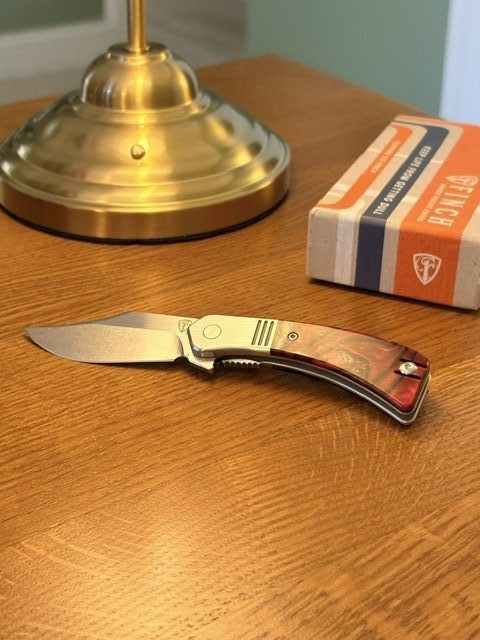
Finch sent me a Snubnose and I want to be honest: I was already excited before I opened it. I've carried the Finch 1929 long enough that it's stopped being a knife I think about and started being a knife I just reach for. The 154CM heat treatment, the design sensibility coming out of Stilwell, Kansas, it's a brand I trust in a way that takes time to earn. So when they offered to send the Snubnose, I said yes and then immediately started managing my expectations. You love one knife from a maker, you assume the next one carries the same weight, and sometimes it doesn't, and you're too polite to say so.
The Snubnose did not give me that problem.
The True Blood Kirinite scales are the first thing you notice, a deep resin with red tones and layered patterning that means no two are identical. It's not a look that tries to be subtle and it doesn't need to be. Against the stonewashed and brushed 154CM blade it's a combination that reads as intentional rather than decorative, confident rather than loud. The finish on the blade itself is worth noting: the satin and stonewash combination gives it the look of a knife that's already been somewhere, which pairs well with something this compact and carry-oriented.
At 2.5 inches the blade is short enough to go anywhere without a conversation, and the snub-nosed geometry, that clipped, purposeful tip, makes it one of the least threatening-looking knives you can put in a pocket while still being genuinely useful. The wire clip is minimal in the best way. At 3.5 oz it carries like it isn't there.
Here's where I'll say something that I mean carefully: there are things about the Snubnose that are better than the 1929. Not better in a way that diminishes the 1929, that knife represents a specific design moment and carries years of daily use in its scales, and I won't be retiring it. But the Snubnose is lighter, more pocketable, less precious. It's the kind of knife you open without thinking about it, use without worrying about it, and put back in your pocket without ceremony. The 1929 taught me what Finch is capable of. The Snubnose showed me that they've kept going. That's what mastery looks like when a maker doesn't stop at the knife that made them, they take what they learned and make something that does a different job just as well or better. The 1929 is the knife I'd carry to a dinner where knives are a conversation piece. The Snubnose is the knife I actually carry everywhere else.
Two weeks in and I haven't reached for anything else. That's not something I say lightly.
Steel154CM · Stonewashed/Brushed
Blade2.5" · Snub nose
Overall6.25"
Weight3.5 oz
HandleTrue Blood Kirinite Resin · 3.5"
ClipWire
Made inStilwell, KS
← Current Fixations
ReviewsApril 2025
Vosteed Corgi V (all black): the knife that doesn't look like a knife

2.4 inches of blacked-out 14C28N, a Vanchor lock, and a realization I had on vacation about what it means for a knife to hide in plain sight.
I was packing up to check out of a hotel room. Sunglasses on the dresser, wallet on the dresser, room key on the dresser, Corgi V on the dresser. I reached for my sunglasses, glanced at the lineup, and for just a moment my eye slid right over the knife. I had to double back and consciously register: that's the knife. It wasn't hiding. It was just sitting there in full view, and it barely read as a knife at all.
The fully blacked-out Corgi V, black aluminum handles, black 14C28N blade, black clip, black hardware, occupies a visual register that has more in common with a tactical pen or a nice lighter than with a folding knife. The symmetrical handle design is part of it: the Corgi platform closes to a profile that's almost perfectly bilateral, no thumb ramp break, no finger groove interruption, no obvious spine orientation from ten feet away. Add the all-black finish and the result is something that reads more as an object than a tool. A device. Something electronic, maybe, or precision-machined for a purpose you can't immediately identify.
This is not an accident, exactly, but I don't think Vosteed set out to make a knife that disappears in plain sight. The visual effect is an emergent property of a design built around symmetry and carry comfort. The 180-degree closing geometry, the blade rotating fully down rather than folding the conventional way, means the closed profile really is that clean. Add the full blackout colorway and it tips over the edge from "compact folding knife" into "ambiguous precision object."
The knife itself is genuinely good at its price. At 2.7–2.9 oz it's light enough to forget. The 2.4" 14C28N drop point flat grinds efficiently and sharpens easily, it's not a premium steel but it performs appropriately for a vacation carry you're using to open packaging, cut food, or do whatever the trip asks. The Vanchor lock engages with a smooth, almost magnetic click that's more satisfying than the price suggests. The dual front flipper and standard flipper openers mean you can deploy it from multiple grips without thinking about it. The reversible clip disappears into the pocket.
What I keep coming back to is what it means for a knife to hide in plain sight rather than hiding in a pocket. Most knives that are "discreet" achieve that by being small enough to be invisible. The blacked-out Corgi V is visible, it's just not identifiable as a knife unless you look at it with intention. That's a different kind of discreet, and it turns out to be more useful in practice. It's the kind of knife you can set on a desk or a table or a hotel dresser without triggering any particular reaction from anyone who sees it, because nobody looking at it is going to immediately categorize it and respond to that category.
I've been calling it the device knife. I don't have a better name for it yet.
← Current Fixations
ReviewsApril 2026
Vosteed Porcupine TiSlim: the TiSlim concept finally with the lock it deserved

S90V, Grade 5 titanium, 0.315" thick. But the real story is the lock, and what it means that Vosteed chose it.
Vosteed introduced the TiSlim concept with the Parallel in 2024: Grade 5 titanium handles machined to an extraordinary 0.28" overall thickness, a crossbar lock, a wire clip, a 2.9" reverse tanto blade. It was a statement knife. The message was that you could have slim-carry titanium EDC performance at a price, $129 for 154CM, $149 for S35VN, that the market hadn't seen for this material tier before.
The Raccoon TiSlim followed the same formula. Same crossbar lock, same Grade 5 titanium construction, 3.18" blade in 154CM or S35VN, starting at $135. It took the beloved Raccoon platform and stripped it down to its essential geometry, keeping the design familiar but making the carry profile dramatically thinner. Both are excellent knives. Both use the crossbar lock.
The Porcupine TiSlim changes one thing, and that one thing matters more than it might initially appear.
The lock argument
The crossbar lock. Benchmade calls theirs AXIS, Kizer calls theirs a button liner, is an excellent lock mechanism for most purposes. Ambidextrous, strong, satisfying to operate. The Parallel and Raccoon TiSlim both benefit from it. But there is a specific way in which the top liner lock on the Porcupine TiSlim is superior for the particular kind of carry these ultra-slim knives are designed for.
A top liner lock actuated by a button keeps your fingers entirely clear of the blade path during both opening and closing. You press the button, the lock releases, the blade folds down, no fingers crossing the edge at any point in the operation. This makes the Porcupine TiSlim significantly more fidget-friendly than its siblings, because you can open and close it one-handed without the careful finger placement that a crossbar lock requires to avoid the edge. In a slim titanium knife you're going to be handling constantly, because the whole point of ultra-thin carry is that it's always in your pocket, that distinction compounds over months of daily use into a meaningfully different experience.
It also means the Porcupine TiSlim is the most office-appropriate knife in the TiSlim family, for the same reason the CJRB Mica and the Artisan Cleo are: a button-actuated lock that closes without fingers in the danger zone reads as deliberate and controlled rather than casual, which matters in professional carry contexts.
The knife itself
The blade is 3.04" of drop point in your choice of 154CM ($139) or S90V ($179). The Grade 5 titanium handles are precision CNC-machined and carefully chamfered at 0.315" total thickness, slightly thicker than the Parallel's 0.28" but still extraordinarily slim for a 3" EDC folder. A large aluminum backspacer reinforces the structure without adding weight. Dual-tone thumb studs in the Porcupine's signature texture. Spine jimping where control matters. A 3D-milled titanium clip that echoes the handle texture. Recessed lanyard hole. Titanium-coated T8 screws.
The S90V version deserves a specific mention: Grade 5 titanium handles and S90V steel at $179 is a combination that should cost considerably more than it does. S90V holds an edge through months of daily carry without complaint. It is harder to sharpen than 154CM when you do need to reset it, diamond stones rather than ceramic, but for a knife this thin that lives in a pocket doing light daily work, you may go a very long time before you need to. The 154CM version at $139 is the more forgiving choice; the S90V at $179 is the one you buy if you want to carry it for a year and not think about sharpening.
154CM · from $139
Porcupine TiSlim (154CM)
3.04" · Grade 5 titanium · top liner lock · 0.315" thick · 2.97 oz
S90V · $179
Porcupine TiSlim (S90V)
3.04" · Grade 5 titanium · top liner lock · acid wash finish · the premium pick
The siblings
If the top liner lock is the wrong choice for your carry style, if you specifically want ambidextrous operation and enjoy the crossbar feel, both TiSlim siblings are worth your time. The ($129–169) is the thinnest of the three at 0.28" and carries the most minimal aesthetic, with a reverse tanto blade that reads as design-forward. The ($135–175) takes the most beloved Vosteed design language and applies the TiSlim treatment to it, which means the ergonomics are deeply familiar if you've carried a Raccoon before. Both excellent. Both crossbar locks.
A note on what comes next
The Porcupine TiSlim is a 3" knife in a package thin enough to forget you're carrying it. The Raccoon TiSlim is a 3.18" knife in a similar package. The Parallel is 2.9". We are holding out hope that Vosteed continues down this path, specifically, that the TiSlim treatment eventually reaches something in the neighborhood of the Corgi V's 2.4" blade and genuinely compact overall geometry. The standard Corgi V at its current dimensions is already a fantastic small carry at $72–82, but a TiSlim version in Grade 5 titanium at this scale would fill a gap in the lineup that nobody else is filling.
The more interesting question is whether such a knife would use a top liner lock, the natural continuation of the Porcupine TiSlim's evolution, or whether Vosteed could engineer a Vanchor lock thin enough to work in a TiSlim handle. The Vanchor lock is the Corgi family's signature mechanism: a fidget-friendly, button-actuated system with a distinctly smooth and magnetic-feeling engagement that's different from a conventional top liner. Getting that mechanism into a sub-0.32" titanium handle without compromising either the lock geometry or the structural integrity of the handle would be a genuine engineering challenge. Vosteed has surprised us before. We wouldn't rule it out.
← Current Fixations
Reviews
Artisan Cleo: the case for S90V in your pocket

A modified wharncliffe blade in CPM-S90V steel. A button lock that releases with the kind of mechanical satisfaction you don't expect at this price. Two handle materials that make the same knife feel completely different. We've been carrying both.
Reviews
September 2025
$149.99 each · KnifeCenter
The Artisan Cleo is a small knife, 2.54 inches of blade in a compact, rounded handle, that makes no small choices about materials. CPM-S90V is a genuine super steel: extremely high wear resistance, excellent edge retention, notably harder to sharpen than mid-tier steels but capable of an edge that lasts long enough to make that sharpening session feel worth it. It's a steel you usually find on knives priced higher than this. Finding it on a $149 production folder with a button lock and titanium scales is the kind of discovery that makes you feel like the knife market is working in your favor for once.
The modified wharncliffe blade geometry is specifically suited to slicing. No belly to speak of, just a straight-to-the-tip edge that draws through material with minimal drag. For food, cord, cardboard, packaging: it's surgical. If you need to pierce something with force, reach for something else. If you need to slice everything in your daily life cleanly and precisely, the wharncliffe is the shape you didn't know you were missing.
The titanium version
CPM-S90V
2.54" blade
modified wharncliffe
sand polish finish
textured titanium handles
button lock
reversible clip
The gray titanium version is the understated one. Milled texturing on the handle gives it grip without aggression, it feels considered rather than tactical. The sand polish on the blade sits between satin and mirror, catching light in a way that reads as refined rather than flashy. In the pocket it weighs almost nothing and disappears completely. This is the version you reach for in professional settings or any situation where you want the knife to be invisible until you need it. The button lock sits naturally under the thumb and releases with a crisp, quiet click. First time you close it one-handed without thinking about it, you'll understand why this lock is gaining ground so fast.
The copper version
CPM-S90V
2.54" blade
sheepsfoot
sand polish / polish finish
raw copper handles
button lock
The copper version is a completely different emotional object in the same mechanical package. Raw copper is alive in a way titanium never is, it starts warming the moment you hold it, and it starts patinating the moment you carry it. Within a month of daily carry the copper will have developed color variations specific to how you hold it, what you keep it next to, your body chemistry. Nobody's copper Cleo looks like anybody else's copper Cleo after sixty days. If the titanium version is the knife that disappears, the copper version is the one you can't stop looking at.
The blade geometry on the copper variant runs slightly more toward sheepsfoot than the titanium, the tip drops down further, making it even more control-forward for fine work. Same S90V steel, same button lock, same fundamental philosophy. Different enough that owning both is genuinely justifiable and not just collector rationalization.
Both versions deserve to be in more pockets than they currently are. Artisan Cutlery doesn't have the name recognition of the brands that charge twice as much for equivalent or lesser performance, and that gap will close eventually. In the meantime, $149 for CPM-S90V in a well-made production folder is a number worth acting on.
← Current Fixations
Reviews
GiantMouse Atelier: when a bar in Nuremberg inspires a masterpiece

The GiantMouse ACE Atelier is named after a bar in Nuremberg that Ansø and Voxnaes love. It is made in Italy. It carries Elmax steel on a sub-3" blade. It is one of those knives you hold and immediately understand that some things have no cheaper equivalent.
Reviews
October 2025
From $220.50 · KnifeCenter
Elmax
2.875" blade
clip point
liner lock
thumb hole opener
wire deep-carry clip
Made in Italy
Micarta or Carbon Fiber or Titanium
GiantMouse has a tradition: they name every knife after a bar or hotel that meant something to them. The Biblio was a bar in Brooklyn where the idea for the brand was born. The Grand is a hotel in Nuremberg. The Clyde is a bar in Portland. The Atelier, which means "workshop studio" in French, is named after a bar in Nuremberg that the team returns to every time they're in the city. There's something consistent and honest about a brand that keeps the names personal rather than aspirational. Every knife is a small marker of a place that mattered.
The Atelier itself is the EDC-sized version of the Grand, which descended from the GM5. GiantMouse's attempt at a magnum opus folder. The goal with the Atelier was to take everything that made the Grand extraordinary and make it pocketable for daily carry. They mostly succeeded. The 2.875" Elmax blade sits in a handle that manages to feel substantial despite the compact dimensions, rounded micarta scales or carbon fiber or machined titanium, all executed with the kind of fit and finish that makes production knife tolerances feel like an aesthetic choice rather than a manufacturing limitation.
Elmax steel is a genuine premium. Wear-resistant, rust-resistant, and capable of an edge that holds through weeks of daily use without complaint. The thumb hole opener is Ansø and Voxnaes paying homage to Spyderco's most elegant solution while making it their own, the hole is oversized and sits precisely where your thumb naturally rests. The wire deep-carry clip is thin enough to be genuinely unobtrusive and secure enough to stay put. Everything on this knife is the result of two people who use and carry knives deciding what they want, rather than what a product team thinks will sell.
At $220.50 for the carbon fiber version and $285 for titanium, the Atelier costs more than most knives in our coverage. It's worth having an honest conversation about that. You are paying for Italian craftsmanship, Elmax steel, and the design judgment of two Danish makers who have been doing this long enough that every choice is deliberate. If those things matter to you, and they should, occasionally, this is money well spent. If you need to be convinced, start with the Riv instead. The Riv will probably convince you.
← Current Fixations
Reviews
Kizer Parakeet: Nitro-V, a button lock, and $58

Johan Jordaan designed this one. 2.46 inches of Nitro-V steel, a button lock, and a price point that makes the existence of certain $100 knives genuinely difficult to justify.
Reviews
December 2025
From $57.95 · KnifeCenter
Nitro-V
2.46" blade
drop point or sheepsfoot
button lock
thumb hole opener
milled aluminum, Micarta, Ultem, or acrylic handles
reversible clip
The Kizer Parakeet is what happens when a brand that knows how to manufacture precisely decides to put genuinely good steel into the Vanguard price tier and stop apologizing about it. Nitro-V is a US-made steel that sits solidly in our recommended mid-tier: excellent corrosion resistance, real toughness, sharpens without drama. Finding it on a $58 knife with a button lock feels like catching something before the market has priced it correctly.
Johan Jordaan's design language is evident throughout, milled anti-slip grooves on both handle and spine, a geometry that fits the hand better than a knife this small has any right to, and a thumb hole opener that works smoothly without the oversized affectation that sometimes makes thumb holes feel performative. The button lock placement is textbook: exactly where your thumb rests naturally when you close the knife. Press, fold, done. Sub-3" blade clears almost every blade length restriction you'll encounter, and the compact closed length means it genuinely disappears in any pocket.
The handle variety is worth noting. PEI Ultem, tan micarta, gray aluminum, clear acrylic, green aluminum. Kizer gave this knife enough handle options that finding one that matches how you dress or what you like to touch is a real possibility rather than a theoretical one. Micarta is the obvious choice for anyone who carries hard; aluminum for anyone who wants the lightest package; acrylic for anyone who wants something visually interesting at a price where interesting handles are usually a fantasy.
At $58 this knife embarrasses things costing twice as much. That's the whole sentence. If you haven't tried the Parakeet and you find yourself spending more than $60 on a sub-3" folder, you owe it to yourself to understand why.
← Current Fixations
Reviews
Knafs Lander 3 clip point: Ben Petersen's most beautiful knife yet

Brown paper micarta. A satin clip point blade. S35VN steel, a clutch lock, open-source scales, ceramic bearings. It looks like something that belongs under a tree. We've looked at it approximately forty times in the last two weeks.
Reviews
November 2025
$128.24 · KnifeCenter
S35VN
2.75" blade
clip point, satin finish
clutch lock
brown paper micarta
ceramic bearings
fast-swap scales
open source
designed in Oregon
The Lander 3 is Ben Petersen taking the best of the original Lander's compact dimensions and adding everything the Lander 2 got right, the clutch lock, the ceramic bearings, the S35VN steel, in a package sized for people who found the Lander 2 just slightly too large for their ideal daily carry. It is, in form factor terms, the original Lander made better in every way that matters. The blade is 2.75 inches. The handle fits the hand with the quiet precision of a design that's been iterated twice before getting here.
The clip point variant specifically is the reason we're writing this in early November rather than waiting for December. That satin clip point blade paired with brown paper micarta handles creates a visual combination that is warm, classic, and genuinely beautiful in a way that most production knives at this price tier aren't trying to be. The bronze thumb stud against the brown micarta is a small detail that lands. The whole thing photographs like it belongs in a still life. It looks, frankly, like a very thoughtful gift, which is partly why we're putting it here and not in the December gift guide.
The clutch lock is the same mechanism that appears in the Lander 2: an AXIS-style crossbar with adjustable omega springs that lets you tune the closing tension to your preference. Ambidextrous, finger-safe, satisfying to operate. The ceramic bearings mean the blade opens faster than most sub-$150 folders have any right to. The fast-swap scales mean you can strip this knife and customize it without touching the pivot assembly, or download handle files from the community and 3D print your own.
Ben Petersen is building something with the Lander series that goes beyond individual knives. Every Lander is a refinement based on what the previous one revealed, and every version is treated as a community canvas rather than a finished product. The clip point Lander 3 is the most beautiful thing that process has produced so far. We think you should own one. We think you should wrap it up and put it somewhere visible in late November and let it do what it clearly wants to do.