Long Term Review: My Friend the Finch 1929
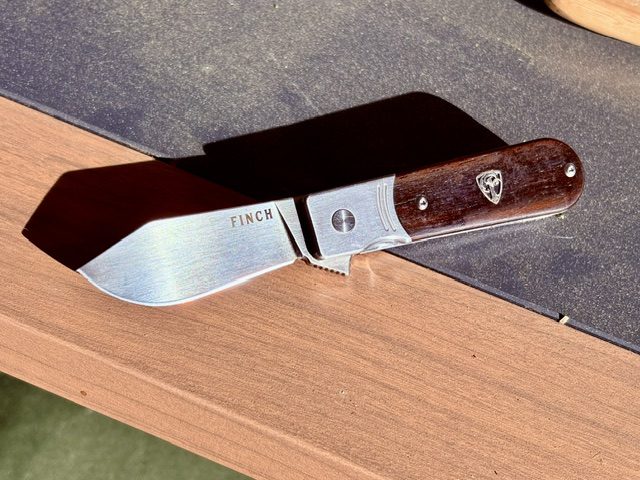
Three years with the ebony wood version. The 1929 is discontinued, which is still a minor injustice, and it remains one of the more thoughtfully considered small folders I've carried. This is an account of what those three years actually looked like.
The Model 1929 is named for the year of the Grand Teton National Park's establishment. Finch's way of anchoring their aesthetic in a specific kind of American outdoors nostalgia that is, depending on your disposition, either charming or the sort of thing you roll your eyes at. I find it charming, partly because the knife earns it. This isn't a brand leaning on vintage associations to justify mediocre hardware. The 1929 is a well-built knife with a genuinely distinctive design language, and the name fits the spirit of the thing without apologizing for it.
Mine is the ebony wood version. The scales are dense, dark, and polished to a finish that photographs like something from a different era, which, again, is either the point or beside it, depending on how you feel about aesthetic intentionality in everyday tools. I feel that it's the point. The ebony has aged well over three years, developing a slight patina at the contact points that makes the knife look like it's been somewhere rather than like it's been neglected. There's a difference, and it's not always easy to achieve deliberately.
The blade shape deserves its own paragraph
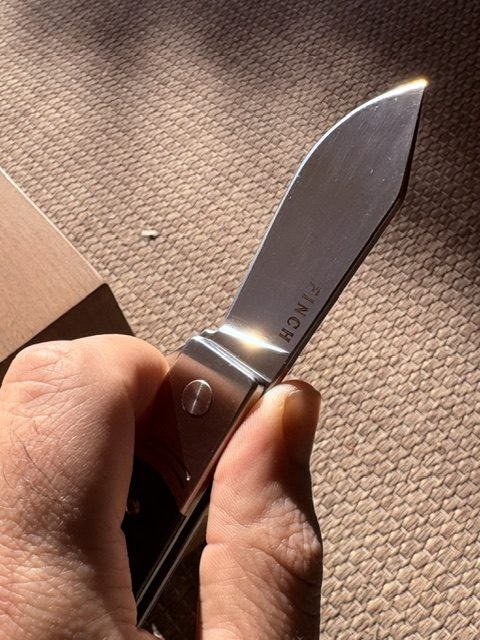
The 1929's blade is unusual enough that people who notice knives tend to notice this one. The geometry sits somewhere between a spay point and a doctor's knife, the spine drops gently toward the tip in a curve that's neither as abrupt as a drop point nor as gradual as a clip point, while the cutting edge has a subtle upward sweep that gives it just enough belly for slicing without becoming a belly-forward blade that loses its tip utility. The tip itself is fine and controllable without being fragile. It's a shape that works across a wider range of cutting tasks than it initially appears to, which is the mark of a blade geometry that was arrived at through considered iteration rather than aesthetic preference alone.
Over three years I've used this blade to open probably several thousand packages, prepare food more times than I can reasonably estimate, cut cord, trim loose threads, and perform the accumulated small cutting tasks that a daily carry knife encounters without ceremony. The geometry has never felt like a limitation. The tip is precise enough for detail work, the belly is present enough for slicing, and the overall length of 2.5 inches hits a specific pocket-knife sweet spot: substantial enough to feel like a real tool in hand, compact enough to disappear in a jeans pocket without a second thought.
154CM and the case for a steel that doesn't get enough credit
154CM has been around long enough that it's acquired the mild stigma of familiarity. It's the steel that premium American knives were made from before S30V arrived and shuffled the hierarchy, and since that transition it's been quietly reassigned to the tier just below "premium" in the collective imagination. This reassignment is, I think, somewhat unfair.
154CM is a high-chromium stainless tool steel with genuinely good edge retention, solid toughness, and corrosion resistance that handles pocket carry without complaint. What it requires is competent heat treatment, because, more than most steels at its tier, the performance spread between a well-treated and a poorly-treated 154CM blade is substantial. This is where Finch earns some genuine credit: the 154CM on my 1929 has been sharpened more times than I've kept track of, and it has consistently responded well, held an edge for a reasonable duration, and not shown any of the brittleness or inconsistency that cheaper 154CM knives occasionally exhibit. Whatever they're doing with the heat treatment, it's working.
Three years on, the edge geometry has been maintained through perhaps a dozen proper sharpening sessions on ceramic stones, with considerably more frequent stropping in between. The steel takes a fine edge without requiring anything more aggressive than a quality medium stone to reset it. For a daily carry knife that gets used daily, not displayed, not rotated, actually used, that's the profile you want.
The integrated liner bolster lock
Finch's integrated liner bolster lock is the structural element that makes the 1929's proportions work. The bolster, visible at the front of the handle as a wide stainless steel component, serves double duty as the visual anchor of the traditional Barlow silhouette and as the locking mechanism itself. The liner lock engagement happens at the bolster rather than at a separate liner component, which allows the handle to be made thinner without compromising lockup rigidity. The result is a knife that handles with the visual weight of a traditional pocket knife but carries with the slimness of a modern production folder.
After three years of daily carry, the lockup remains solid. There's no measurable blade play and no deterioration in the lock's engagement position. This isn't remarkable for a quality knife at this price point, it's simply what should happen, and I mention it because three years is long enough to be meaningful evidence rather than early optimism.
What three years actually looks like
The ebony scales have darkened slightly at the contact areas, the thumb side of the handle where it presses against denim, the area just forward of the clip. The darkening is even and reads as wear rather than damage. The titanium clip has a few fine scratches from pocket debris that are visible at certain angles and invisible at others. The blade has the faint circular marks of a sharpening stone on the flat near the edge, which I've never bothered to polish out because they don't affect function and seem honest. The hardware, pivot screws, stop pin, clip screws, is all original and all tight.
The knife looks, in other words, like it has been carried for three years by someone who actually carries knives. Not abused, not neglected, not preserved. Used. This is, I think, the best possible outcome for an everyday carry tool.
The 1929 is discontinued and occasionally appears on the secondary market at prices ranging from fair to optimistic. If you find one at a reasonable price, particularly in ebony or cocobolo, buy it without extended deliberation. The blade geometry is genuinely distinctive, the 154CM performs well above its reputation when treated properly, and the knife carries in a way that makes you forget it's there until you need it, which is the whole point. Finch built something here that deserved a longer production run. The fact that it didn't get one is the knife hobby's loss, not the knife's.
If you can't find the 1929: what Finch is making now
Finch releases new models on a roughly annual cycle, and their current lineup carries the same design DNA as the 1929, bolstered handles, considered blade geometries, American outdoors aesthetic, applied to different form factors. Three worth knowing about:
The Snub Nose is probably the closest current analog to the 1929 in spirit, compact, bolster-locked, with handle options that lean into the same traditional aesthetic. The 2.75" blade in 154CM with the bolster lock system is a direct continuation of the design philosophy, and the handle material options (abalone, mother of pearl, standard scales) offer similar variation to what the 1929 had. If you liked the 1929 and want something current, this is where to start looking.
A departure from the bolster lock in favor of a frame lock, but the same 154CM and the same Finch design sensibility. The wharncliffe blade geometry is a different proposition from the 1929's spay-point hybrid, more precise, less belly, excellent for controlled cutting tasks. At $155 for 154CM and stainless bolsters it's priced in keeping with what Finch charges for quality hardware and American-brand positioning. Three color options in the two-tone finish that are worth seeing in hand before judging from product photography.
The Devil's Finger is Finch's lower-priced entry, using 14C28N instead of 154CM and G10 handles instead of bolstered scales. It's a meaningful step down in materials from the 1929 or the Snub Nose, but at $85 it's also a different kind of ask. 14C28N is a capable daily carry steel, tougher than 154CM, easier to sharpen, slightly lower edge retention, and G10 handles in the available color combinations (blue echo, claymore, neon on black) are honest and durable. For someone new to Finch who wants to understand what the brand does before committing to $149+, the Devil's Finger is a reasonable first experiment.